In the dynamic and complex financial landscape, businesses face numerous risks related to cash management, liquidity, investments, and financial transactions. To ensure transparency, accountability, and the overall financial well-being of an organisation, it is imperative to conduct thorough audits of the treasury department. Such audits play a vital role in identifying potential weaknesses, mitigating risks, and enhancing the effectiveness of the treasury function.
Safeguarding Financial Assets
The treasury department of a business is responsible for managing and safeguarding its financial assets, including cash, investments, and banking relationships. An audit of the treasury department provides an independent and objective evaluation of its operations, ensuring that adequate controls are in place to protect these valuable assets from fraud, misappropriation, or mismanagement.
Risk Identification and Mitigation
Conducting regular audits of the treasury department enables the identification and assessment of various financial risks. These may include liquidity risk, foreign exchange risk, interest rate risk, credit risk, and operational risk. By scrutinising processes, controls, and risk management strategies, auditors can help mitigate these risks and strengthen the organisation’s financial stability.
Ensuring Compliance
The treasury function is subject to various regulatory requirements, internal policies, and industry standards. Audits of the treasury department ensure compliance with applicable laws and regulations, including banking regulations, tax laws, and financial reporting requirements. Additionally, audits help confirm adherence to internal policies and procedures, providing assurance that the treasury operations are conducted ethically and in line with the organisation’s governance framework.
Validating Financial Reporting
The treasury department’s activities directly impact the financial statements of a business. Auditing the treasury function ensures the accuracy and reliability of financial reporting by validating the completeness and accuracy of treasury-related transactions. Auditors review treasury-related accounts, reconciliations, and documentation to ensure proper recording, classification, and disclosure of financial information.
Operational Efficiency and Effectiveness
A comprehensive treasury audit assesses the efficiency and effectiveness of treasury operations. Auditors evaluate the treasury department’s processes, systems, and controls to identify areas for improvement and recommend best practices. This can lead to streamlining processes, enhancing operational efficiency, and optimizing the use of financial resources.
Identifying Cost Savings Opportunities
Treasury audits can uncover cost savings opportunities by identifying inefficiencies, redundancies, or unnecessary expenditures. By examining bank fees, interest rates, investment performance, and cash management practices, auditors can recommend strategies to reduce costs, negotiate better terms with financial institutions, and maximize returns on investments.
Strengthening Governance and Accountability
Auditing the treasury department fosters good governance practices and accountability within an organisation. It provides an independent assessment of the treasury function’s performance, risk management, and adherence to policies and procedures. This transparency reinforces the organisation’s commitment to responsible financial management and builds trust among stakeholders, including investors, lenders, and regulatory bodies.
How can My Audit Spot help?
We have built a basic Treasury Department Audit Program, outlining basic processes and controls most Treasury Departments should have in place. You can buy the template here.
The importance of auditing the treasury department in a business cannot be overstated. By conducting regular and thorough audits, organisations can identify and mitigate risks, ensure compliance, validate financial reporting, enhance operational efficiency, and strengthen overall governance and accountability. The insights and recommendations provided by auditors enable businesses to make informed decisions, improve treasury practices, protect financial assets, and maintain a solid foundation for sustainable growth. Investing in treasury audits is a proactive step towards maintaining financial integrity and safeguarding the organization’s long-term success.

Example Internal Audit Work Program / Risk and Control Matrix (RCM)

Maintaining appropriate controls over the revenue and billing process, such as ensuring only valid invoices are raised, and checks against credit notes are performed, is important to ensure there is no fraud, the business is meeting any local regulatory requirements and the business is making best use of its available cash flow.
We have developed a generic Internal Audit Work Program, or Risk and Control Matrix (RCM) aimed at helping audit teams ensure controls over the revenue and billing process have been designed and implemented correctly, and are also operating effectively.
The testing work program is built within our example ‘Excel’ audit file. The test plan has also been mapped to an example audit scope and objectives, and includes example risks and controls. See below for an extract from the example work program file.


To view a free version of this template, please click here.
To purchase a copy of this template, please click here.
Want all of our templates? Become a member. Members can access all of the templates from the members area here.
As always, this is a generic template. You should review this template in detail and edit accordingly so it is suitable for your business.
How and why you should perform a risk assessment over the end to end process when planning an internal audit

The International Standards for the Professional Practice of Internal Auditing (Standards) require auditors to assess the risks of each engagement. Specifically, the Standards state the following:
2210 – Engagement Objectives
Objectives must be established for each engagement.
2210.A1 – Internal auditors must conduct a preliminary assessment of the risks relevant to the activity under review. Engagement objectives must reflect the results of this assessment.
There are many ways in which audit teams can assess the risks associated in the engagement. These can include:
- Process walkthroughs
- Review of the risk register
- Review of any controls / assurance activities already in existence
- Review of prior audit activity
- Meetings with key stakeholders
Fact is, each of these items are sufficient in assessing the risks of the overall process, however where audit teams often fall behind, is their ability to consolidate each of these activities into a central tool which provides an overview of the end to end process, risks throughout the process, and our final risk assessment.
My Audit Spot have developed a Process Level Risk Assessment tool. You can view some images of this below:


To view a free copy of the template, please click here.
To purchase a copy of this template, please click here.
Members can download a copy from the members area here. Not a member, click here to become a member today.
As the audit team performs the various walkthrough and meetings with key stakeholders, there is a significant amount of knowledge which is being obtained. Whilst this should be all documented in our various planning workpapers, it is beneficial for a team to meet together for a ‘Team Planning Day’.
During a Team Planning Day, all team members should be able to bring together what they have learnt to build a high level process flow. The high level process flow should identify the key steps in the end to end process which is currently being audited. For each high level step, the team should list each of the identified controls, known risks and possible risks.
Using the guidance slide in the template, team members should then be able to consistently assess the likelihood and impact of the risk eventuating for each of the key steps in the process. Once this has been determined, team members, and particularly audit teams with limited resources, will be able to identify the most high risk areas of the audit. This will allow them to build a more targeted audit scope and objective, but also a more appropriate test plan which proportionally addresses the risks identified. For instance, a low risk step within the end to end process should not have the same level of audit attention as a high risk area, unless audit resources are available.
Let is know how your audit team meets the Standards by assessing the risk in each audit engagement.
Cost effective solution for managing your Internal Audit department without spending big

Small Internal Audit teams often face many challenges; one of these being how to efficiently manage their function on a minimal budget.
Whilst larger teams may have the luxury of an end to end audit system (or Governance, Risk and Control tool), such as Galvanise, Team Mate, Workiva, and Pentana, these tools often cost quite a bit of money and are in excessive of your current department’s needs. As such, smaller audit functions often resort to multiple excel documents which are manual, time intensive, and run the risk of being corrupted and obsolete.
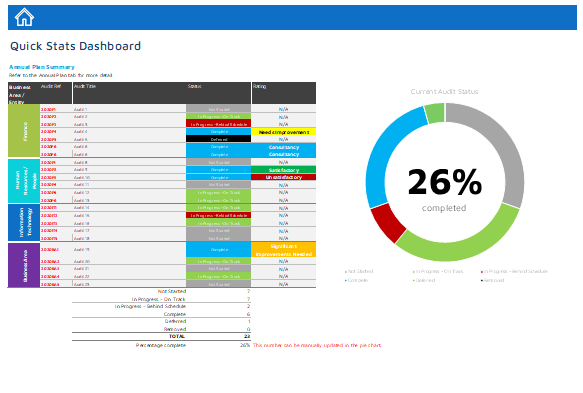
To help combat these challenges, we have developed an Audit Database tool. The tool has been built in Excel, meaning those who are Excel savvy can easily edit and manipulate the tool to suit the needs specific to their department and business. The Audit Database tool is a cost effective solution which provides the following:
- Audit Summary – A summary of the current annual plan status
- Annual Plan – Overview of the Annual Plan including resource allocation
- Audit Universe – Overview of the entity and current audit coverage.
- Risk Register – Overview of the current company risk register which integrates into the Audit Universe.
- Action Tracking Tool – Database to track all your open action items.
- Audit Committee Dashboard – A series of graphs and tables which can be directly copied and pasted into your audit committee deck template.
A brief snapshot of the database tool can be seen in the images below. Alternatively, you can view the free PDF version here.



To purchase a copy of this database tool, simply click here:
Members can download the tool as part of their membership in the Members Area. Not a member? Become a member here.
My Audit Spot are able to help you set up and establish your Database Tool so that it meets the needs of your function and your business. To discuss how we can help you, please contact us here.
Example Internal Audit Work Program / Risk and Control Matrix (RCM)

Maintaining appropriate controls over travel and expenses, such as ensuring travel is purchased in compliance with the Policy and appropriately approved, is important to ensure there is no fraud, the business is achieving value for money with all necessary business travel.
We have developed a generic Internal Audit Work Program, or Risk and Control Matrix (RCM) aimed at helping audit teams ensure controls over the travel and expenses process have been designed and implemented correctly, and are also operating effectively.
The testing work program is built within our example ‘Excel’ audit file. The test plan has also been mapped to an example audit scope and objectives, and includes example risks and controls. See below for an extract from the example work program file.


To view a free version of this template, please click here.
To purchase a copy of this template, please click here.
Want all of our templates? Become a member. Members can access all of the templates from the members area here.
As always, this is a generic template. You should review this template in detail and edit accordingly so it is suitable for your business.